 The Yongnuo RF-603 is a wireless system for triggering flash and/or camera shutter using the FSK 2.4 GHz channel. Control distances up to 100 meters are claimed. Transmitter and receiver are identical and are called transceivers. The transceivers are powered by two standard AAA batteries; 45 hours of standby are claimed. Sixteen channels are available to provide isolation from other RF-603 that might be nearby.

The RF-603 is offered as the RF-603C for Canon cameras and RF-603N for Nikon cameras. I’ve not seen the Nikon version but apparently there are slight electronic differences in addition to differences in the hot shoe and cable connections. The Canon version uses a 2.5mm socket for connection to the camera and a standard PC socket for connection to studio flashes. On the camera end, the connecting cable varies according to the camera connection. Cameras such as Canon’s 1D, 5D, 7D, 20D use the “C3” cable whereas the 60D, 450D, 1000D and similar use the “C1” cable. My G12 and G1X also use the “C1” cable.
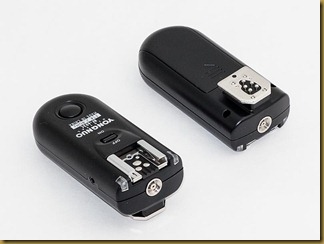
The RF-603C came well packed and worked right out of the box. I must admit that, at first, I thought the triggers were defective because I immediately mounted a flash to the hotshoe of a transceiver and tried to trigger it by pressing the button on the other transceiver. The RF-603 doesn’t work that way. It turns out that pressing the transceiver button does not activate the hotshoe on another transceiver. The button activates the shutter release connection – not the hotshoe connection on the receiving transceiver. As a flash trigger, the RF-603 can be tested by mounting the flash to the hotshoe of one transceiver, placing the other transceiver on the camera hotshoe and firing off a shot.
Channel selection is done by setting the switch that is beneath the batteries. I immediately changed the channel from the factory setting. Each transceiver must be set to the same channel.

Here’s a funny about the RF-603 package: The box has dual labels in English and Chinese (I assume). The User Manual is also in English and Chinese. Inside the box was a small package of desiccant label “DO NOT EAT” – but only in English!
Prior to getting the RF-603, my preferred remote trigger was the RF-602 although I first learned about remote flash triggers by using the Cactus V2. The Cactus V2 had an iffy performance that seemed mostly related to connections and wiring. After getting the RF-602, I stopped using the V2.
So far, I’ve not seen much difference in the performance of the RF-603 as compared to the RF-602 when used as a simple flash trigger. I had hoped (in vain!) that my G1X fitted with the RF-603 might not exhibit “screen blanking” as it did with the RF-602. However, this is obviously more of a problem (or undocumented feature) with recent PowerShots than it is related to the specifics of the flash accessory. The RF-603C worked fine with my 7D.

Compatibility-wise, the RF-603C seems to trigger every flash I have access to – even the Nikon SB-28 and SB-24. Remember though, that all the RF-603 does is to signal “Fire” to the flash. The flash power must be set manually on the flash. It appears that the RF-603 cannot be triggered by the RF-602 and vice versa.

There are two main gripes about the RF-603: First, the OFF/ON switch is virtually inaccessible after the flash is mounted to the trigger hotshoe. This means that the trigger must be turned ON before mounting it to the flash. Second, the trigger just slides into the camera hotshoe – there is no lock. Although this friction only mounting is actually relatively secure, it does not fill me with confidence so I’ll be applying a bit of gaffer tape.
The RF-603 is very versatile and can be used in a variety of triggering modes but I’ll save those details for a separate post.


