.
Although I’ve made several postings about focusing the G9 (sort of cross referenced here), a few days ago I began to think that my G9 was focusing much better when held horizontally (landscape) than when held vertically (portrait). In fact, sometimes it would not focus when turned vertically. Was my G9 broken?
On further review, I’ve come to realize that the small Flexizone frame works best on vertical lines when held horizontally and on horizontal lines when held vertically. Said another way, when shooting in landscape orientation (the “normal” shot), look for a vertical line on which to focus. When shooting a portrait, look for a horizontal line and focus on it.
My problem – when I feared my G9 was broken – was that I was shooting in portrait orientation and the subject lines were vertical. The G9 just would not focus on those vertical lines with the small Flexizone frame. But turning the camera to landscape orientation, it focused immediately.
In much the same way, when using the small Flexizone frame, the G9 struggles to focus on simple horizontal lines when the camera is in landscape orientation. Turned vertically, focusing is routine on those same horizontal lines.
The AiAF matrix of focus points does not have this problem – probably because one of the focus points usually finds an appropriate contrast pattern.
I still prefer the small Flexizone frame but now have a better understanding of those missed focuses. Strange, but true.
.
Showing posts with label AiAF. Show all posts
Showing posts with label AiAF. Show all posts
Monday, January 5, 2009

Monday, August 11, 2008
G9: Focus Conclusions
.
It’s time to force myself to document my conclusions about focusing the G9. When the G10 is announced, I’ll get caught up in all the hoopla. So here’s what I’ve learned and concluded as well as my current focusing practices for the G9.
First a summary of the G9 focus posts:
Introduction to G9 focusing
Focusing outdoors
Focusing indoors
Face detection
G9 use of hyperfocal focus
G9 hyperfocal chart
Problems focusing on low contrast subjects
Beeps when focused
After all this, I still prefer to use the small Flexizone frame, recompose and shoot when I have the time to do so. Yes, I know this can be slow and methodical, but that’s me as well. For repetitive shots, I often get small Flexizone frame focus, switch to manual and continue shooting. I focus this way for macros when the G9 is tripod mounted.
For landscape shots, I often use manual focus set to infinity. It's easy and certain but be sure to switch back to auto focus!
When wild and crazy and partying, it’s just better to set the G9 on face detection focusing – especially if the camera is passed around a bit. Usually, but not always, face detection works well.
OK, the focusing post is done, where’s the G10?
.
It’s time to force myself to document my conclusions about focusing the G9. When the G10 is announced, I’ll get caught up in all the hoopla. So here’s what I’ve learned and concluded as well as my current focusing practices for the G9.
First a summary of the G9 focus posts:
Introduction to G9 focusing
Focusing outdoors
Focusing indoors
Face detection
G9 use of hyperfocal focus
G9 hyperfocal chart
Problems focusing on low contrast subjects
Beeps when focused
After all this, I still prefer to use the small Flexizone frame, recompose and shoot when I have the time to do so. Yes, I know this can be slow and methodical, but that’s me as well. For repetitive shots, I often get small Flexizone frame focus, switch to manual and continue shooting. I focus this way for macros when the G9 is tripod mounted.
For landscape shots, I often use manual focus set to infinity. It's easy and certain but be sure to switch back to auto focus!
When wild and crazy and partying, it’s just better to set the G9 on face detection focusing – especially if the camera is passed around a bit. Usually, but not always, face detection works well.
OK, the focusing post is done, where’s the G10?
.
Sunday, July 13, 2008
G9: Face Detection Focusing
.
In previous posts, the various ways of focusing the G9 along with the concept of hyperfocal distance were presented. Along with the various ways of focusing the G9, I discovered a few perculiarities – to me anyway – both indoors and outdoors.
Up to this time, I’ve only briefly mentioned face detection focusing and pointed out that the G9 switches to AiAf focus mode if no faces are detected. It’s time to delve into face detection in more detail.
Like more than a few photographers, when I first heard about face detection, I laughed. How could it be effective? Who would need it? Well, it turns out that face detection has evolved rapidly, is quite effective and most people benefit from face detection focusing. For example, in my family, like most families, we take a lot of snapshots. We set a snapshot camera on full auto, pass it around and tell young and old to take a few shots. The G9 can do all this and does it well -- especially in face detection mode.
In the past several months, I’ve been a snapshooter at several parties and family get-togethers. I tried face detection focusing in desperation and, to my surprise, it worked. In fact, I’ve switched our snapshot camera, a Canon SD800, to face detection.
I don’t know how face detection focusing works. A computer program uses pattern recognition algorithms based on the shape of typical faces, eye spacing, color, hair, etc. to select a subject and then set focus on that subject. The Canon G9 is sometimes said to detect up to nine faces but the instruction manual says that up to three frames display where the G9 detects faces. When the G9 is in face detection mode, the LCD display shows the detection frames lock onto a face. Fascinating.
.jpg)
Natually, I attempted to trick the face detection algorithm and set up this award winning composition. Hey, aren’t these faces? However, the G9 said that no faces were detected (Elmo and friends were insulted) until the portrait was included. The G9 immediately locked onto the portrait as a “face” onless the portrait was placed near an edge of the composition. Interesting. This picture was taken in manual exposure mode without flash at f3.2, 1/30 second and ISO 800 in face detection mode.
Face detection focusing is said to include enhancements to improve exposure, especially when using flash. I hope this is true but I didn’t notice any differences during the tests of this scene. I also tried a few self portraits using the 10 second delay but, again, did not notice any difference in flash exposure with or without face detection. In my other uses of face detection, I don’t have comparative images.
I don’t doubt that face detection improves flash exposure but I don’t have proof at this point. I’m late coming to face detection but expect to be using it more frequently in the future. Stay tuned, but in the meantime, try face detection.
.
In previous posts, the various ways of focusing the G9 along with the concept of hyperfocal distance were presented. Along with the various ways of focusing the G9, I discovered a few perculiarities – to me anyway – both indoors and outdoors.
Up to this time, I’ve only briefly mentioned face detection focusing and pointed out that the G9 switches to AiAf focus mode if no faces are detected. It’s time to delve into face detection in more detail.
Like more than a few photographers, when I first heard about face detection, I laughed. How could it be effective? Who would need it? Well, it turns out that face detection has evolved rapidly, is quite effective and most people benefit from face detection focusing. For example, in my family, like most families, we take a lot of snapshots. We set a snapshot camera on full auto, pass it around and tell young and old to take a few shots. The G9 can do all this and does it well -- especially in face detection mode.
In the past several months, I’ve been a snapshooter at several parties and family get-togethers. I tried face detection focusing in desperation and, to my surprise, it worked. In fact, I’ve switched our snapshot camera, a Canon SD800, to face detection.
I don’t know how face detection focusing works. A computer program uses pattern recognition algorithms based on the shape of typical faces, eye spacing, color, hair, etc. to select a subject and then set focus on that subject. The Canon G9 is sometimes said to detect up to nine faces but the instruction manual says that up to three frames display where the G9 detects faces. When the G9 is in face detection mode, the LCD display shows the detection frames lock onto a face. Fascinating.
Natually, I attempted to trick the face detection algorithm and set up this award winning composition. Hey, aren’t these faces? However, the G9 said that no faces were detected (Elmo and friends were insulted) until the portrait was included. The G9 immediately locked onto the portrait as a “face” onless the portrait was placed near an edge of the composition. Interesting. This picture was taken in manual exposure mode without flash at f3.2, 1/30 second and ISO 800 in face detection mode.
Face detection focusing is said to include enhancements to improve exposure, especially when using flash. I hope this is true but I didn’t notice any differences during the tests of this scene. I also tried a few self portraits using the 10 second delay but, again, did not notice any difference in flash exposure with or without face detection. In my other uses of face detection, I don’t have comparative images.
I don’t doubt that face detection improves flash exposure but I don’t have proof at this point. I’m late coming to face detection but expect to be using it more frequently in the future. Stay tuned, but in the meantime, try face detection.
.
Friday, June 27, 2008
G9: Focusing Indoors
.
As previously noted, although the G9 has five automatic focusing modes, I almost always choose the small Flexizone frame centered in the LCD. I place the focus frame on the subject of interest, push the shutter button halfway, think “focus”, check for the frame to turn green, recompose the scene and finish pressing the shutter. To get additional shots from the same vantage point, I then switch to manual focus and keep the previous focus distance. This method almost always works well even if it is a bit slow and methodical.
Without recomposing, the small Flexizone frame may not detect enough contrast to obtain focus. Also, without recomposing, the small Flexizone frame may focus on the wrong object. This is particularly a problem when photographing indoors. To illustrate this problem, I set up my G9 on a tripod and tried the various focusing methods indoors.
In this scene, the G9 was set for the widest angle, 7.4mm; the aperture was f4.5 (the “Sweet Aperture”) . The image shown was downsized from the in-camera JPEG. The focus distance, as determined by the small Flexizone frame was 15 feet but the large Flexizone frame determined the focus to be 8 feet! This discrepancy occurred because the small frame fell on a photo on the opposite wall but the large frame included a chair. The focus distance, as determined by the small AiAF matrix was 12 feet. The large AiAF matrix also determined the focus to be 12 feet. Interestingly, the large AiAF matrix did not always lock onto the same object even though the G9 was on a tripod. I had suspected that the different focus methods would lock onto different objects and I was correct.
Using manual focus, I dialed in 5 feet and took another shot. Later, to my surprise, all the pictures look essentially the same. Why? Of course, the explanation is hyperfocal distance. For the 7.4mm zoom focal length and f4.5 aperture, everything from about 4 feet to infinity is in acceptable focus. In setting up my test, I’d forgotten about the hyperfocal distance. Chalk one up for the G9.
Since this humbling experience, I’ve toyed with the various focus modes quite a bit. My basic hypothesis was correct: With any focus mode other than the small Flexizone frame, I cannot be certain of getting the exact focus point that I want. Fortunately, often it just doesn’t matter.
But sometimes it does .... (more later)
.
As previously noted, although the G9 has five automatic focusing modes, I almost always choose the small Flexizone frame centered in the LCD. I place the focus frame on the subject of interest, push the shutter button halfway, think “focus”, check for the frame to turn green, recompose the scene and finish pressing the shutter. To get additional shots from the same vantage point, I then switch to manual focus and keep the previous focus distance. This method almost always works well even if it is a bit slow and methodical.
Without recomposing, the small Flexizone frame may not detect enough contrast to obtain focus. Also, without recomposing, the small Flexizone frame may focus on the wrong object. This is particularly a problem when photographing indoors. To illustrate this problem, I set up my G9 on a tripod and tried the various focusing methods indoors.
In this scene, the G9 was set for the widest
 angle, 7.4mm; the aperture was f4.5 (the “Sweet Aperture”) . The image shown was downsized from the in-camera JPEG. The focus distance, as determined by the small Flexizone frame was 15 feet but the large Flexizone frame determined the focus to be 8 feet! This discrepancy occurred because the small frame fell on a photo on the opposite wall but the large frame included a chair. The focus distance, as determined by the small AiAF matrix was 12 feet. The large AiAF matrix also determined the focus to be 12 feet. Interestingly, the large AiAF matrix did not always lock onto the same object even though the G9 was on a tripod. I had suspected that the different focus methods would lock onto different objects and I was correct.
Using manual focus, I dialed in 5 feet and took another shot. Later, to my surprise, all the pictures look essentially the same. Why? Of course, the explanation is hyperfocal distance. For the 7.4mm zoom focal length and f4.5 aperture, everything from about 4 feet to infinity is in acceptable focus. In setting up my test, I’d forgotten about the hyperfocal distance. Chalk one up for the G9.
Since this humbling experience, I’ve toyed with the various focus modes quite a bit. My basic hypothesis was correct: With any focus mode other than the small Flexizone frame, I cannot be certain of getting the exact focus point that I want. Fortunately, often it just doesn’t matter.
But sometimes it does .... (more later)
.
Friday, June 6, 2008
G9: Can’t Focus

.
Sometimes the G9 can’t focus. When the G9 has acquired focus, it beeps twice (very quickly) and the AF frame on the LCD turns green. If the G9 is confused about the focus, it only beeps once and the AF frame turns yellow. That (yellow frame) was the case for this uncropped image. For this composition – as attractive as it is – the small AF frame did not include any details and the G9 could not focus. I pressed the shutter button anyway and got an out-of-focus picture.
Switching to manual focus immediately after the shot, I found that the G9 decided to focus at infinity instead of the true distance of about nine feet. Had I selected the nine large frame AiAF focus method, the G9 would have focused correctly because some of the frames would have included the plaques (tested and proven).
As noted previously, I almost always use the small Flexizone frame for focusing. I even leave the frame centered; that is, I focus, recompose and shoot. But sometimes, especially when in a hurry, this is not the best method and it definitely is not the best method without recomposing.
The G9 focuses by means of contrast detection and tends to select the closest object. When using the small AF frame to focus, make certain that the focus frame includes an edge, some sort of pattern, different colors, different lighting, etc. In fact, when using the large frame or the multiple AiAF frames, keep in mind that the focus point will be selected on the basis of proximity and contrast.
And watch for that frame to turn green!
Sometimes the G9 can’t focus. When the G9 has acquired focus, it beeps twice (very quickly) and the AF frame on the LCD turns green. If the G9 is confused about the focus, it only beeps once and the AF frame turns yellow. That (yellow frame) was the case for this uncropped image. For this composition – as attractive as it is – the small AF frame did not include any details and the G9 could not focus. I pressed the shutter button anyway and got an out-of-focus picture.
Switching to manual focus immediately after the shot, I found that the G9 decided to focus at infinity instead of the true distance of about nine feet. Had I selected the nine large frame AiAF focus method, the G9 would have focused correctly because some of the frames would have included the plaques (tested and proven).
As noted previously, I almost always use the small Flexizone frame for focusing. I even leave the frame centered; that is, I focus, recompose and shoot. But sometimes, especially when in a hurry, this is not the best method and it definitely is not the best method without recomposing.
The G9 focuses by means of contrast detection and tends to select the closest object. When using the small AF frame to focus, make certain that the focus frame includes an edge, some sort of pattern, different colors, different lighting, etc. In fact, when using the large frame or the multiple AiAF frames, keep in mind that the focus point will be selected on the basis of proximity and contrast.
And watch for that frame to turn green!
.
Sunday, May 25, 2008
G9 Hyperfocal Chart
.
Continuing the series on focusing the G9, knowledge of the hyperfocal distance is extremely useful when focusing any camera. Previous postings have included observations about the G9’s use of hyperfocal focusing and depth of field for closeups.
Somewhat loosely speaking, but easy to remember, is that if a camera is set for the hyperfocal distance then everything from that distance to infinity is acceptably in focus. In fact, everything from half that distance to infinity is in focus. For more details, check Wikipedia .
A most useful reference for both hyperfocal distance and depth of field is DOFMaster . Since both hyperfocal distance and depth of field vary with digital sensor size and focal length, here’s a chart of hyperfocal focusing distance specifically for the Canon G9 that was made by using the DOFMaster online calculations.

In addition to the hyperfocal distance, the table includes the near/far distance that is in focus when the G9 is focused at 10 feet. Why 10 feet? When the G9 is first turned on and switched to manual focus, it is set for (roughly) 10 feet.
Here’s an example of how the chart can be used. With your G9 turned off, set the Av mode at f5.6. Now turn the G9 on. The default focal length is the wide angle (7.4mm focal length) when the G9 comes on in Av mode. Immediately, switch to manual focus. You’ll see that the default focus distance is about 10 feet. Referring to the chart above for the 7.4mm lens, the hyperfocal length at an aperture of f5.6 is 5.3 feet. This means that, if the focus distance had been set for 5.3 feet then every distance from 2.65 feet (=5.3/2) to infinity would have been in focus. However, the default distance is 10 feet so everything from 3.5 feet (near focus) to infinity is in focus.
The G9 almost does not require focusing at the wide angle setting! But this happy situation changes dramatically at the longer focal lengths as shown in the chart.
Since aperture, focal length and manual focus distance can be saved as a custom setting (page 109 in the manual), the G9 can be preset for special situations -- including hyperfocal focusing.
.
Continuing the series on focusing the G9, knowledge of the hyperfocal distance is extremely useful when focusing any camera. Previous postings have included observations about the G9’s use of hyperfocal focusing and depth of field for closeups.
Somewhat loosely speaking, but easy to remember, is that if a camera is set for the hyperfocal distance then everything from that distance to infinity is acceptably in focus. In fact, everything from half that distance to infinity is in focus. For more details, check Wikipedia .
A most useful reference for both hyperfocal distance and depth of field is DOFMaster . Since both hyperfocal distance and depth of field vary with digital sensor size and focal length, here’s a chart of hyperfocal focusing distance specifically for the Canon G9 that was made by using the DOFMaster online calculations.

In addition to the hyperfocal distance, the table includes the near/far distance that is in focus when the G9 is focused at 10 feet. Why 10 feet? When the G9 is first turned on and switched to manual focus, it is set for (roughly) 10 feet.
Here’s an example of how the chart can be used. With your G9 turned off, set the Av mode at f5.6. Now turn the G9 on. The default focal length is the wide angle (7.4mm focal length) when the G9 comes on in Av mode. Immediately, switch to manual focus. You’ll see that the default focus distance is about 10 feet. Referring to the chart above for the 7.4mm lens, the hyperfocal length at an aperture of f5.6 is 5.3 feet. This means that, if the focus distance had been set for 5.3 feet then every distance from 2.65 feet (=5.3/2) to infinity would have been in focus. However, the default distance is 10 feet so everything from 3.5 feet (near focus) to infinity is in focus.
The G9 almost does not require focusing at the wide angle setting! But this happy situation changes dramatically at the longer focal lengths as shown in the chart.
Since aperture, focal length and manual focus distance can be saved as a custom setting (page 109 in the manual), the G9 can be preset for special situations -- including hyperfocal focusing.
.
Friday, May 23, 2008
G9: Focus on Focusing
.
The G9 automatic focus methods are:
Flexizone – a single rectangular frame normally in the center of the display but which can be moved as desired. The frame can be large or small. The G9 focusing logic sets the focus distance so that the object in this frame is in focus.
AiAF – A 3x3 matrix of rectangular frames in the center of the display. These frames can be large or small. Only the small frame matrix can be moved off center. The G9 focusing logic somehow selects one or more of these frames and sets the focus distance accordingly. (“AiAF” apparently means “Artificial Intelligence Auto Focus” but I can’t find that definition in the manual.)
Face Detection – Magically, the G9 detects faces (or objects resembling faces) and sets the focus accordingly.
The autofocus mode is a menu setting (page 116 of the manual) as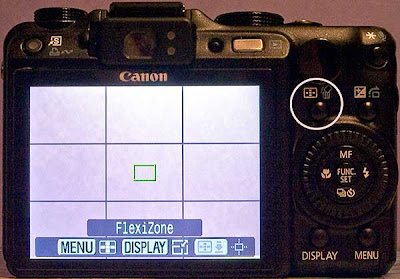 shown above but can also be set with a few button presses on the back of the G9 as shown here. First, with the G9 in shooting mode, press the AF frame button (numbered 19 on page 42 of the manual) shown circled here. The display will change as shown (but with the current AF frame selection). The AF frame selection is then toggled between Flexizone, AiAF and Face Detection by pressing the Menu button, examples are shown below.
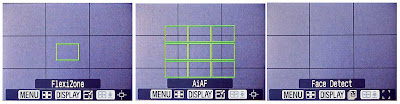
For Flexizone and AiAF, the size of the frame can be changed by pressing the Display button, the smaller frames are shown below. Both Flexizone and the small AiAF frames can be moved with the Control Dial.
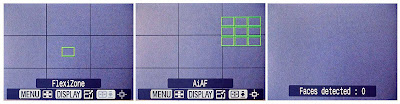
When in Face Detection mode, pressing the Display button indicates how many faces are detected.
When using the G9, I always recommend pressing the shutter button halfway to achieve focus. Once focus is achieved, the G9 gives two quick beeps and the focus frame turns green.
My normal practice is to use the small Flexizone frame in the center position to obtain focus on the subject of interest. I press the shutter button halfway to achieve focus, hold the button at the halfway position, recompose and shoot. To get a second or similar shot, I might switch to manual focus because the manual focus position is retained until the next autofocus.
.
The G9 is an extremely versatile camera. Among its many options 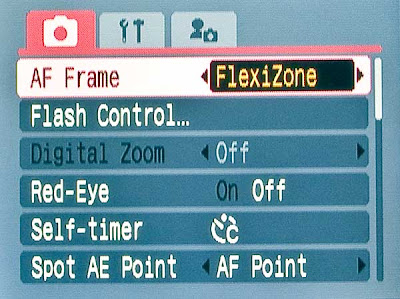 are (at least) five different choices for automatic focusing methods plus manual focus. I’ve always used the same method in the past but it is past time to learn the others so the next several posting will be about focusing the G9.
 are (at least) five different choices for automatic focusing methods plus manual focus. I’ve always used the same method in the past but it is past time to learn the others so the next several posting will be about focusing the G9.
 The G9 automatic focus methods are:
Flexizone – a single rectangular frame normally in the center of the display but which can be moved as desired. The frame can be large or small. The G9 focusing logic sets the focus distance so that the object in this frame is in focus.
AiAF – A 3x3 matrix of rectangular frames in the center of the display. These frames can be large or small. Only the small frame matrix can be moved off center. The G9 focusing logic somehow selects one or more of these frames and sets the focus distance accordingly. (“AiAF” apparently means “Artificial Intelligence Auto Focus” but I can’t find that definition in the manual.)
Face Detection – Magically, the G9 detects faces (or objects resembling faces) and sets the focus accordingly.
The autofocus mode is a menu setting (page 116 of the manual) as
 shown above but can also be set with a few button presses on the back of the G9 as shown here. First, with the G9 in shooting mode, press the AF frame button (numbered 19 on page 42 of the manual) shown circled here. The display will change as shown (but with the current AF frame selection). The AF frame selection is then toggled between Flexizone, AiAF and Face Detection by pressing the Menu button, examples are shown below.
For Flexizone and AiAF, the size of the frame can be changed by pressing the Display button, the smaller frames are shown below. Both Flexizone and the small AiAF frames can be moved with the Control Dial.
When in Face Detection mode, pressing the Display button indicates how many faces are detected.
When using the G9, I always recommend pressing the shutter button halfway to achieve focus. Once focus is achieved, the G9 gives two quick beeps and the focus frame turns green.
My normal practice is to use the small Flexizone frame in the center position to obtain focus on the subject of interest. I press the shutter button halfway to achieve focus, hold the button at the halfway position, recompose and shoot. To get a second or similar shot, I might switch to manual focus because the manual focus position is retained until the next autofocus.
.
Subscribe to:
Posts (Atom)