Sunday, October 28, 2012

Ten Novels: Favorites or Somehow Remembered

Diverting from the usual program, here are my top ten novels (why ten? Well, I’m an engineer and, besides, have ten fingers). Not necessarily in any particular order:

  • “The Time Keeper” by Mitch Albom
  • “Illusions - The Adventures of a Reluctant Messiah”, by Richard Bach
  • “Time and Again” by Jack Finney
  • “Joshua” by Joseph Girzone
  • “Cold Sassy Tree” by Olive Ann Burns
  • “A River Runs through It” by Norman Maclean
  • “The Catcher in the Rye” by J.D. Salinger
  • “The Sound and the Fury” by William Faulkner
  • “Cannery Row” by John Steinbeck
  • “This Random Sky” by James L. Summers
  • “The Red Car” by Don Stanford
  • “The Mudhen” by Merritt Parmelee Allen

Somehow, each of these novels have impressed me enough that I’ve kept a copy and read them more than once. I think I’ve read “Illusions” at least four times and began to re-read “The Time Keeper” immediately after finishing it the first time.

As for favorite novelists, I usually begin by naming Steinbeck, Hemingway and Twain but on making this list realize that I’ve not re-read any Hemingway in many years.

As I list these novels, the sad thing is that my own is not among them – apparently, you have to actually write it down before it can be printed. I have taken ten pretty good photographs though.

Thursday, October 18, 2012

G7–> G15?

G6

When the G6 was announced in 2004, I already had a G3 and, although tempted, decided not to upgrade to the G6. After a while, it seemed that the G6 was the end of the line for the G series but then the G7 was a surprise announcement in 2006. The G7 has been followed by a new G series every year from 2007 through 2010 when, once again, there was a two year gap and rumors of the G series coming to an end. Those rumors ended with the announcement of the G15 a few weeks ago.

(As a side note, the G4 and G8 model names were skipped in the past just as the G13 and G14 names have been skipped most recently. That is, there was no G4 or G8. Amusingly, the G4 and G8 are sometimes praised on Internet discussion forums for their quality and features. I expect the same praise to eventually be awarded to the G13 and G14.)

The G7 was a nice looking compact camera but did not have the articulated display screen featured in previous G series models. To my further disappointment, the G7 did not produce RAW image files.  To many people, these shortcomings meant that the G7 was not a “real G”.  All G models after the G7 have included RAW image capability but the articulated display screen did not return until the G11. I passed on the G7 but bought a G9, then a G12 and most recently a G1X.

My point (and yes, there is one) is that there was a two year gap between the G6 (which had an articulated display screen) and the G7 (which did not). There was also a two year gap between the G12 (which had an articulated display screen) and the new G15 (which does not). The G7 was viewed as a test of the compact camera enthusiast market. Is the G15 also a test of the market?

Fortunately, the G15 can produce RAW image files. In fact, the G15 seems to be more like a G12 that has been made more compact (by eliminating the articulated display) than it does an updated G7.

Will there be a G16? Who knows? My thinking is that Canon currently offers too many enthusiast compact cameras (G1X, G15, S110, EOS-M and an advanced EOS-M essentially announced). I expect that, depending on sales volume (of course), either the G1X or G15 will be dropped. But, as Canon has shown in the past, “dropping” a product may really mean a two year gap until the next model is announced.

G3,6,9,12

Oh yes, I eventually bought a used G6 just to complete the “set” (G3, G6, G9, G12). Does that mean I’ll someday have a G15?

Monday, October 8, 2012

RF-603 PC Connection

RF-603

In addition to the hotshoe and shutter connections, the RF-603 also has a threaded (“screw lock”) PC connection at the squared off end of the body, see above.  (In the world of photography, “PC” once meant Prontor/Compur and not “Personal Computer”.) The intent of the PC connection is to connect to flashes that do not have a hotshoe. My set of  RF-603s did not include PC connection cables so I ordered some from eBay (search for “Male to Male Flash PC Sync Cable Cord for Yongnuo RF-603” – can’t get much more specific than that!). My order was placed with “Jiakgong” in China. These cables were less than $3 each so I ordered 4 cables. Shipping was only $1.40; seems like it took about two weeks to receive the cables. The cables were loosely packed with no documentation but seem OK and I gave positive feedback on the transaction.

RF-603 PC

The eBay cables indeed fit the RF-603 – first test passed. Next, I wondered if the RF-603 could trigger two flashes in the same way that worked for the  RF-602. The trick with the RF-602 was to use one flash in the hotshoe and connect the second flash with the cable. I tested this configuration with two old Nikon SB-24 flashes, the RF-603 and the PC cables as shown below.

RF-603

It works!

RF-603

Saturday, September 29, 2012

RF-603 Triggering Modes

RF-603

Most of the time, my RF-603 will be used in the simple manner shown above: transceiver in the hotshoe of my 7D and wirelessly triggering a remote flash or two. However, the RF-603 can be used as a shutter trigger or even combined shutter and flash trigger.

RF-603 (G1X)

In the previous post, I noted that the button on the RF-603 transceiver activates only the shutter release (side connection using 2.5mm plug) and not the hotshoe functions. As shown above, the RF-603 can be used as a simple wired shutter release. Press the shutter button and the camera fires but remote flashes will not be triggered.

RF-603 (G1X)

The configuration shown above will trigger both camera and remote flashes.  Place a transceiver in the hotshoe of the camera and connect its shutter release to the camera. Add a second transceiver to trigger the hotshoe transceiver. Now a press of the button on the second transceiver triggers the shutter release on the first transceiver (the one mounted on the camera hotshoe) and the camera fires. When the camera fires, the hotshoe mounted transceiver transmits a signal to any RF-603 that are listening and those flashes will fire. To operate in this mode, three transmitters are needed: one on the camera hotshoe, a second transmitter to be the shutter trigger and a third transmitter mounted on the flash.

RF-603

Actually, the “third” transmitter (the one mounted on the flash as shown above) can be used to trigger the transmitter mounted on the camera hotshoe so really only two transmitters are needed. In other words, set up a RF-603 on the camera hotshoe and wired to the camera release connection plus a second RF-603 mounted on the flash hotshoe as shown below. When the button on the flash mounted RF-603 is pressed, the camera will fire and activate the RF-603 on the camera hotshoe which will trigger the flash mounted RF-603 to fire the flash having the transceiver that began the cycle.

RF-603 (G1X)

All this is simpler than the words necessary to describe it.  Just remember that the button activates the 2.5mm connection and the hotshoe activates remote hotshoes.

Monday, September 17, 2012

G15: How ‘bout that!

20120917_hiRes_g15_3q

As rumored and becoming obvious over the past few days, Canon announced its PowerShot G15 enthusiast’s camera today – a replacement for the G12 but skipping the G13 and G14 product names for various reasons of their own.

The Canon website now includes product pages for the G15. Dpreview has a preview of the G15.

My own guess, was that the G12 marked the end of that product line but that descendants of the G1X would continue it. I'm wrong once again (although more nearly correct a year ago).

Instead of the G12 being the end of a product line, I now suspect that the G1X will be a one-off model line because Canon's enthusiast compact product line seems to be getting crowded. Perhaps Canon is floating trial balloons to see which way the market winds are blowing.

I also suspect that the G15 probably was spec'd and designed very quickly in response to the moderate reception given the G1X. With the exception of a faster lens, the G15 appears to be a modest update to the G12. Since I still have my G12 and have added the G1X, I don’t feel particularly inclined to purchase a G15.

More later as I read and learn about the G15.

Thursday, September 13, 2012

Yongnuo RF-603

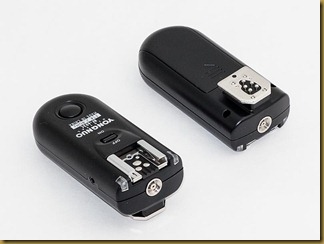
RF-603The Yongnuo RF-603 is a wireless system for triggering flash and/or camera shutter using the FSK 2.4 GHz channel. Control distances up to 100 meters are claimed. Transmitter and receiver are identical and are called transceivers. The transceivers are powered by two standard AAA batteries; 45 hours of standby are claimed. Sixteen channels are available to provide isolation from other RF-603 that might be nearby.

RF-603

The RF-603 is offered as the RF-603C for Canon cameras and RF-603N for Nikon cameras. I’ve not seen the Nikon version but apparently there are slight electronic differences in addition to differences in the hot shoe and cable connections. The Canon version uses a 2.5mm socket for connection to the camera and a standard PC socket for connection to studio flashes. On the camera end, the connecting cable varies according to the camera connection. Cameras such as Canon’s 1D, 5D, 7D, 20D use the “C3” cable whereas the 60D, 450D, 1000D and similar use the “C1” cable. My G12 and G1X also use the “C1” cable.
RF-603

The RF-603C came well packed and worked right out of the box. I must admit that, at first, I thought the triggers were defective because I immediately mounted a flash to the hotshoe of a transceiver and tried to trigger it by pressing the button on the other transceiver. The RF-603 doesn’t work that way. It turns out that pressing the transceiver button does not activate the hotshoe on another transceiver. The button activates the shutter release connection – not the hotshoe connection on the receiving transceiver. As a flash trigger, the RF-603 can be tested by mounting the flash to the hotshoe of one transceiver, placing the other transceiver on the camera hotshoe and firing off a shot.

Channel selection is done by setting the switch that is beneath the batteries.  I immediately changed the channel from the factory setting.  Each transceiver must be set to the same channel.

RF-603

Here’s a funny about the RF-603 package: The box has dual labels in English and Chinese (I assume). The User Manual is also in English and Chinese. Inside the box was a small package of desiccant label “DO NOT EAT” – but only in English!

Prior to getting the RF-603, my preferred remote trigger was the RF-602 although I first learned about remote flash triggers by using the Cactus V2. The Cactus V2 had an iffy performance that seemed mostly related to connections and wiring. After getting the RF-602, I stopped using the V2.

So far, I’ve not seen much difference in the performance of the RF-603 as compared to the RF-602 when used as a simple flash trigger. I had hoped (in vain!) that my G1X fitted with the RF-603 might not exhibit “screen blanking” as it did with the RF-602. However, this is obviously more of a problem (or undocumented feature) with recent PowerShots than it is related to the specifics of the flash accessory.  The RF-603C worked fine with my 7D.

RF-603

Compatibility-wise, the RF-603C seems to trigger every flash I have access to – even the Nikon SB-28 and SB-24. Remember though, that all the RF-603 does is to signal “Fire” to the flash. The flash power must be set manually on the flash. It appears that the RF-603 cannot be triggered by the RF-602 and vice versa.

RF-603

There are two main gripes about the RF-603:  First, the OFF/ON switch is virtually inaccessible after the flash is mounted to the trigger hotshoe.    This means that the trigger must be turned ON before mounting it to the flash.  Second, the trigger just slides into the camera hotshoe – there is no lock.  Although this friction only mounting is actually relatively secure, it does not fill me with confidence so I’ll be applying a bit of gaffer tape.

The RF-603 is very versatile and can be used in a variety of triggering modes but I’ll save those details for a separate post.

Friday, September 7, 2012

G1X: Battery Options

NB-10L

Canon’s G1X uses an NB-10L rechargeable lithium-ion battery rated at 7.4 volts DC and having a capacity of 920 mAh. The NB-10L is also used in Canon’s SX40 HS camera and probably many others. Canon rates its battery for approximately 250 still shots with the display screen turned on or 700 with the display screen off; this rating assumes “normal” operation which includes zooming. The battery is reported to be rated for 300 charging cycles. Of course, Canon’s instruction book for the G1X says “Use only the recommended battery.”.

In contrast to the NB-10L as used in the G1X, the NB-7L as used in the G12 is rated for 370 shots with the display turned on or 1000 shots with the display off. The NB-7L is also a 7.4 volt battery but with a capacity of 1050 mAh. The NB-7L is slightly larger than the NB-10L.

G1X CameraMany G1X users interpret “recommended battery” to mean the NB-10L type of battery and not necessarily the Canon brand. Canon’s NB-10L is much more expensive than non-Canon batteries. Typically Canon’s NB-10L is around $40 and as high as $60 whereas generic NB-10L range from $10 to $20 and really cheap ones are less than $10.

So – what’s a photographer to do?

Coming from a time when batteries were not as reliable and had a lower capacity, my personal and recommended practice is: one in the camera, one in the pocket and one in the charger. Being even more conservative, I’m likely to have an additional battery or two around. At the same time, all my extra batteries are the generic variety.

My personal G1X is usually powered by the official Canon battery. Along with my G1X, I purchased a “Power2000” NB-10L which, as I recall, was about $20 at the time. The Power2000 NB-10L is rated for 1200 mAh. Later I went even cheaper with two “Photive” NB-10L batteries costing $20 – including a charger useable with either AC or adaptable to an automobile DC socket (cigarette lighter). Come to think of it, I’ve not tested the DC socket charger.  Hmm, better test it someday (Update:  Seems to work!). Like the Power2000, the Photive NB-10L are labeled as having 1200 mAh capacity.

I believe/suspect that there are few rules for determining battery capacity or, more likely, that the temptation to use an exaggerated capacity is very strong. In my very limited testing and experience, it seems that the OEM and non-OEM batteries have about the same capacity. That is, don’t be misled by the mAh capacity label. My practice is to use a “Sharpie” pen to mark batteries as received. Of course, the received date is not the same as the manufactured date but is somewhat indicative of the age of the battery. It seems to me that generic batteries have a slightly shorter lifetime than do OEM batteries.

Following are some sources for NB-10L batteries. (This blog is not linked to any commercial sites or agreements.)

  • B&H has a Pearstone NB-10L for $20. It is highly rated in the B&H system of ratings.
  • Adorama has their private labeled NB-10L for $10.
  • Sterlingtek has a good reputation and is a source used by many photographers. Sterlingtek has been my first choice for non-OEM batteries for many years. Strangely, Sterlingtek does not carry the NB-10L on their website but even more strangely, Amazon carries an NB-10L ($15) supplied by Sterlingtek that is highly rated. I don’t understand this at all.
  • Amazon has some very cheap NB-10L batteries. Some are as low as $4 and others are packaged with chargers and other accessories. Wow, the Power2000 is about $4 and has a good rating – makes me feel like getting another one!

Various Internet discussion forums have positive comments about NB-10L batteries supplied by GT Max NB-10L, Sterlingtek (through Amazon), B&H, Ex-Pro and Opteka. It is easy to get the idea that the marketer (not the same thing as manufacturer) does not matter. The difference is probably the specifications and tolerance requirements of the marketer. One begins to suspect that there are very few manufacturers and that many of these batteries are actually made by the same manufacturer.

I’ve followed this philosophy and practice for some time. Here’s a post about a clone battery failing in my G9 and two posts about batteries used in my 7D.

My recommendation?  Buy a cheap generic battery for backup; in fact, buy several.