.
I've made several Blurb books, learned a lot in the process and (I hope) am getting better at both editing and book design. Previously, Blurb allowed 15 page "previews". Now, a Blurb author can choose to allow unlimited previews. I've opened my Swiss Army Knife book and my dad's autobiography to full previews.
Update: Just like last year, my entry to Blurb's Photography Book Now (Swiss Army Knives at Work and Play) did not win, place, or show -- or get mentioned at all. Oh well, I like it and voted for it. Wait 'til next year!
Lessons Learned: Not all, but a significant number of the winning or mentioned books in Blurb's Photography Book Now contest used a very simple design: blank page on the left page, one large print on the right page. Sometimes the left hand page includes the caption or a comment about the right hand page. This is especially interesting considering that Blurb offers so many page templates and variations on design. No doubt I've been using overly complex designs and layouts.
.
Friday, September 25, 2009

Sunday, September 20, 2009
G9: Wide Angle Converter Outdoors
.
Previously, I showed the effects of using the Canon wide angle converter lens with my G9 indoors in a small room. Here’s a outdoor shot:

Without the wide angle converter, the scene looks like this:

Both shots were taken from a tripod with the G9 set for ISO 80 and manual exposure of 1/125 second at f4.5. Focus distance was manually set at infinity. These images are from the in-camera JPEG and downsized for display.
The purpose of this post was intended to be a comparison of the angle of view but, once again, that bright white fence is difficult to capture. Pixel peeping a bit, the fence is worse with the wide angle conversion lens as shown below.

The comparison above is the 1” x 1” section that would be printed at 300 dpi. That is, each crop contains 300 pixels and is shown here at 100% scale.
In fairness, I have to admit that every picture I’ve taken of that white fence using my G9 on a bright day shows chromatic aberration. Obviously, the wide angle converter makes the result even worse.
Although glad to have it, I haven’t used the wide angle converter as much as I thought but that doesn’t stop me from wanting an easily accessible 24mme lens.
Previously, I showed the effects of using the Canon wide angle converter lens with my G9 indoors in a small room. Here’s a outdoor shot:
Without the wide angle converter, the scene looks like this:
Both shots were taken from a tripod with the G9 set for ISO 80 and manual exposure of 1/125 second at f4.5. Focus distance was manually set at infinity. These images are from the in-camera JPEG and downsized for display.
The purpose of this post was intended to be a comparison of the angle of view but, once again, that bright white fence is difficult to capture. Pixel peeping a bit, the fence is worse with the wide angle conversion lens as shown below.
The comparison above is the 1” x 1” section that would be printed at 300 dpi. That is, each crop contains 300 pixels and is shown here at 100% scale.
In fairness, I have to admit that every picture I’ve taken of that white fence using my G9 on a bright day shows chromatic aberration. Obviously, the wide angle converter makes the result even worse.
Although glad to have it, I haven’t used the wide angle converter as much as I thought but that doesn’t stop me from wanting an easily accessible 24mme lens.
.
Saturday, September 5, 2009
G9: Wide Angle Converter Indoors
.
In a previous post I showed my Canon wide angle conversion lens for my G9. Yes, it's an awkward thing but, given that I have the G9, can be useful both indoors and outdoors. The picture below is the widest angle view of a small bedroom that can be captured with the normal G9 lens (35mme).

The next view is with the camera (tripod mounted) in the exact same position but with the wide angle converter attached to yield a 26mm equivalent lens.

At first, the increased angle of view is not so impressive; however, it is significant. Note that the 26mme of the G9+converter is slightly wider than the 28mme of the G10/G11.
.
Friday, August 28, 2009
G11 Negative Thoughts
.
When I first saw the specifications and features for the G11, I was disappointed. I’d already predicted the specs and features for the G11 and my prediction was substantially wrong. After a few days, I became more interested in the G11 and, in the previous post, took a positive attitude about the G11. In this post, I get to vent my frustrations and unfulfilled wishes for the G11.
No CMOS! I had predicted a CMOS sensor for the G11 not because of my expertise in sensor design but because of my faith in Canon and because Canon has built a manufacturing plant specifically for compact camera CMOS sensors. Canon uses CMOS sensors in all its DSLR cameras and I wanted their demonstrated expertise to be applied to the G11. Now I cynically take the opposite view: Canon fully expected to make a high quality, low noise CMOS sensor for the G11 but, in fact, could not do so. As a result, Canon had to hurriedly choose a CCD sensor from an outside source (widely believed to be Sony) and to accept the compromised performance of that sensor in their new G11 camera. (Cowardly Disclaimer: This is my own, personal conclusion and viewpoint. I have no data or information whatsoever to support my belief.)
No large sensor! Along with the CMOS sensor, I also predicted a slightly larger sensor for the G11. Now I think that Canon probably planned to use the same size sensor, albeit with fewer pixels than the G10, all along. I can understand their (assumed by me) reasoning but the G10/11 is increasingly being compared to its Micro Four Thirds (MFT) competitors and MFT cameras have larger sensors than do the Canon G series cameras. I did not expect an MFT size sensor for the G11 but fully expected one that could be advertised as “larger” -- meaning in comparison to the G10.
No HD video! This is the obvious indicator of the compromised sensor. Everyone expected HD video in the G11. Granted, not all users want video but there is an obvious convergence of still and motion photography underway in the digital cameras. The G11 is even being promoted by Canon as a photojournalist’s camera. Come on! The lack of HD video will probably be the first item on anyone’s list of surprises about the G11.
No voice recorder! Apparently this feature, available on my G9, has been omitted from the G11. No voice recorder in a photojournalist’s camera?
No superwide! The 28mme focal length is a reasonable choice for the wide end of the zoom but where is the optional conversion lens? The G11 lens is (apparently) the same as the G10 lens and Canon has not offered a wide angle conversion lens for the G10.
There, now I feel better – and my list of complaints is not as long or as serious as I thought it would be.
.
Tuesday, August 25, 2009
G11 Positive Thoughts
.
As it became apparent that August 19 was really THE DAY for the G11 announcement, the rumors could be taken a bit more seriously; however, the most accurate rumor was certainly a disappointment. I was disappointed not only because I’d made my own prediction and now had to account for it but because the G11 did not appear to be the exciting upgrade to my G9 that I’d wanted. I decided there would be no G11 in my future.
Now that the smoke has cleared (well, actually the discussion forums, such as the Powershot forum at DPReview are really heating up), the G11 really does have some features and potentials that interest me. Here’s my personal list – in some kind of meaningful order – as gleaned from the published specs and the G11 manual.
1. Wide angle lens (28mme). Not as wide as I wanted (24mme) but an improvement over the 35mme of my G9.
2. Articulated display – a “real” G series to many people. I liked that feature on my old G3.
3. Wired remote. Although I use the Franiec cable release on my G9, I like the idea of the wired remote – and I already have one!
4. Improved dynamic range and higher usable ISO. Although data and comparisons are not available at this time, I have no doubt that the G11 will have less noise and increased dynamic range than the G9 and, for that matter, the G10.
5. Intelligent contrast correction. This in-camera processing option might help to save some post processing for those occasions when I don’t post process from RAW mode.
6. Decreased shutter lag. Actually this is just implied and is probably only for Quick Shot Mode.
I’m curious about these features but wouldn’t buy the G11 just to get them:
- Quick shot mode
- Registering commonly used menus
Whereas my first impression of the G11 was “Not for me” now I’m on the fence and trying to make up my mind. I’ve gone so far as to put my name on a waiting list but frankly am happy that the G11 is not available for ordering at this time.
.
Sunday, August 23, 2009
G9 Shutter Lag
. 
I’m one of the complainers about shutter lag with my G9 – even in manual mode – and, in the midst of a debate on a DPReview forum decided to conduct my own tests. But how to do so? At first, I imagined all sorts of timer circuitry, switches, etc. but since I don’t really know how to do that sort of thing, finally decided to try simply taking a photo of my computer screen. This crude approach actually worked surprisingly well – sort of.
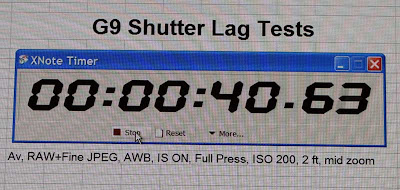
I searched for an on screen timer and downloaded XNote Timer . This is a basic and free version of their more comprehensive XNote Stopwatch. The image above is one of the several hundred shots I took of XNote Timer from my LCD. (I know, I know – sort of sad, isn’t it?)
I was especially curious about differences in shutter lag with and without Image Stabilization (IS), the effect of the half-pressed shutter button (sometimes called pre-focus) and the quickness of all manual mode with IS off, display off, etc.
Both Imaging Resource and DPReview publish shutter lag values but their test results did not completely satisfy my curiosity. According to Imaging Resource, the G9 shutter lag is from 0.57 seconds at wide angle to 0.69 seconds at telephoto. When prefocused, the shutter lag is 0.088; with manual focus (but presumably auto exposure) the shutter lag is 0.58 seconds. According to DPReview, the full press lag is about 0.6 seconds; the half press lag is about 0.12 seconds with the LCD turned on but decreases to about 0.05 seconds if the LCD is off. I don’t have any particular reason to dispute these values.
No, the shutter lag of my G9 was never the 40.63 seconds in the picture. After starting XNote Timer, I took a picture every 10 seconds. (I watched the computer monitor – not the G9 display.) So the example represents the 4th shot and the delay was 0.63 seconds. I usually took a dozen shots (2 minutes worth), discarded any obvious long or short times and averaged those remaining. Here’s what I found.
Base Case (my typical setup): Av mode, RAW+JPEG, display on, evaluative metering, small flex frame focus, shot only IS on, AWB. Full press lag = 0.61 seconds.
Same as Base Case (above) but timed from shutter button half-pressed: Lag = 0.15 seconds! In spite of the crudeness of my method, the improvement in shutter lag was obvious. Additionally, I found that the half pressed shutter button reduced shutter lag time to about 0.15 seconds no matter what options were selected in the menu or function settings.
Base Case but with manual exposure, manual focus, IS off. Lag = 0.23 seconds. This test was done with a full length press of the shutter button. Again, lag was reduced to about 0.15 seconds when the shutter button was half pressed prior to completing the press.
In some tests, turning IS off shaved about 0.1 seconds from the shutter lag but other times there was no measured effect on the average time. All these tests were hand held and perhaps I was more steady some of the time. I’d guess that IS probably adds about 0.1 seconds to the lag.
Interestingly, I found that by turning off RAW and using JPEG only, setting white balance (instead of using auto white balance) and reducing resolution to M3 with Normal compression reduced shutter lag by about 0.2 seconds from the Base Case. This was unexpected but perhaps not really correct because by that time I was getting pretty good at taking the shutter lag test. As I got better and better at taking the shutter lag test, I even recorded some negative shutter lag! That is, I jumped the gun a bit while anticipating the 10 second interval. As my own lag improved, the first series of tests had to be repeated.
So I learned some things about shutter lag. The very best technique is, as expected, to first press the shutter button halfway to obtain focus, exposure, set the IS, etc. Complete the shutter button press on seeing/hearing the G9 confirm that it is ready. Full manual mode (manual exposure and manual focus with display off, IS off) is better than I’ve been crediting it.
Granted, this technique isn’t great but it was an instructive exercise and perhaps will be useful to others. My own reflexes are not particularly quick so these speeds should be easily beaten. Try a few variations and learn more about shutter lag.
.
Wednesday, August 19, 2009
G11 Announced
.
Canon’s G11 was announced today. The announcement was expected but I was very surprised by the feature set of the G11. I’d made my own G11 prediction a few months ago but didn’t exactly hit the mark. Well, taking a more positive attitude, I did get a few things right: the name G11; same form, appearance, controls but a little larger; same focal lengths and apertures; fewer pixels but higher ISO; highlight recovery option. Perhaps not so terrible after all.
On the down side, I completely missed the mark with my prediction of a 12MP CMOS sensor manufactured by Canon that would be slightly larger than the G10 sensor. The G11 uses a 10MP CCD sensor and, at this point, the manufacturer is not known. The G11 sensor is the same size as the G10 sensor.
Even more surprising to me is that the G11 does not include HD video. Actually, I’m shocked at this omission. It never even occurred to me that HD video would not be in the G11 feature set. The omission of HD video in the G11 is probably a serious marketing error by Canon. (Having said this, I must admit to using movie mode very infrequently on my G3 and G9 but was looking forward to trying HD video with my next camera. Also, I’m well aware that the need for HD video in a compact camera is a much debated topic among photographers.)
The G11 even has the articulated display screen in spite of my prediction that it would not. However, I’m happy to have been wrong!
Other features that I mis-predicted include: launch date (I thought September); price (a good thing!); new lens (apparently is the same as the G10); pixel binning at ISO 12800 (instead of 6400) – sounds interesting; new conversion adapter (will use the G10 adapter); RAW files from AUTO mode.
The G11 may also have some minor tweaks to shutter lag and flash performance. There’s a new mode, “Quick Shot”, that sounds interesting but is not described in detail.
Canon’s launch information leads me to believe that ISO 400 and possibly 800 might be routinely usable with respect to noise. Of course, noise and noise reduction are greatly debated topics and others may very well disagree. With my G9, I was beginning to feel OK about ISO 400 after suitable processing. The G11 would appear to have the potential to go to even higher ISO speeds.
As always, DPReview has additional information and summaries. I’m looking forward – and impatiently so -- to their review of the G11.
.
Subscribe to:
Posts (Atom)